How to Evaluate an Agentic RAG System Without Lying to Yourself
A practical framework for measuring retrieval, agent behavior, generation quality and business outcomes in production-grade agentic RAG applications.
Large Language Model evaluation is already difficult.
Evaluating an agentic Retrieval-Augmented Generation system is significantly harder.
An agentic RAG application is no longer a single model generating a response from a prompt. The system makes decisions. It selects tools, performs retrieval operations, plans intermediate steps, retries failed actions and synthesizes information from multiple sources before producing an answer.
Traditional LLM evaluation approaches that focus primarily on the final answer therefore miss an important question:
Did the system arrive at the answer through reliable, repeatable and explainable behavior?
In production, that distinction matters.
A system that occasionally produces the correct answer through luck may still fail when exposed to scale, changing data, unusual queries or new user behavior.
This article presents a practical framework for evaluating agentic RAG systems across four layers:
- Retrieval
- Agent behavior
- Generation
- Business outcomes
The goal is not simply to measure whether the final answer looks correct.
The goal is to understand why the system succeeded or failed.
The Production Problem
Consider an enterprise knowledge assistant used by customer support engineers.
The assistant may need to:
- Understand the user's problem
- Query a vector database
- Retrieve troubleshooting guides
- Search historical support tickets
- Call internal APIs
- Decide whether escalation is required
- Generate a grounded response
A simplified workflow might look like this:
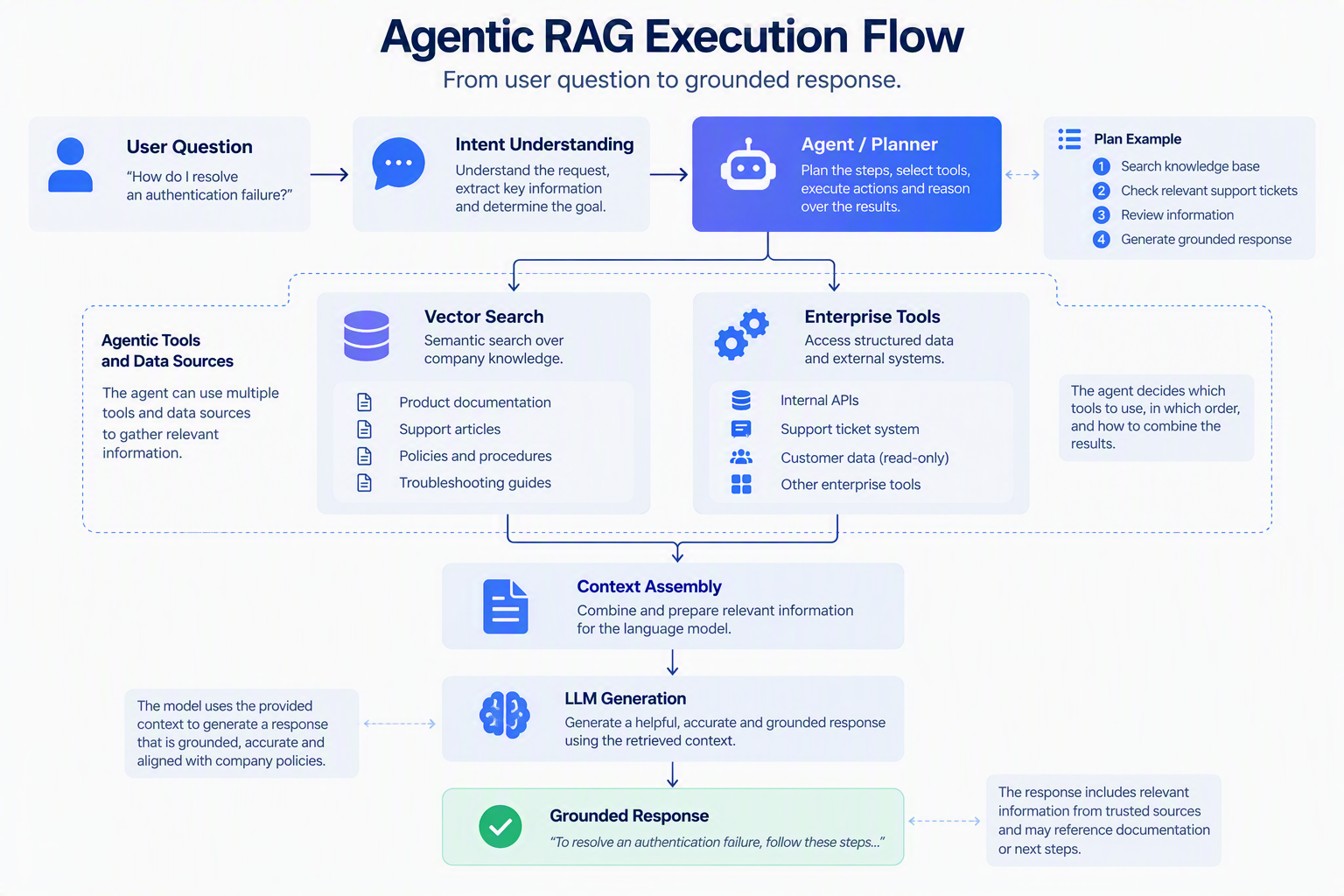
An agentic RAG workflow introduces multiple decision and execution points, creating a larger failure surface than conventional retrieval-augmented generation.
Unlike conventional RAG, the failure surface is much larger.
The answer may be wrong because:
- Retrieval missed the relevant document
- The agent selected the wrong tool
- A tool returned stale data
- Context assembly exceeded useful context limits
- The model hallucinated
- The planner followed an inefficient path
- The system ignored critical evidence
- A dependency failed and recovery logic was ineffective
Evaluating only the final answer provides very little information about which component actually failed.
Why Traditional LLM Evaluation Falls Short
Many teams begin with a simple benchmark:
| Question | Expected Answer | | --- | --- | | How do I reset a Product X token? | Follow procedure Y | | What is the support SLA? | Premium SLA is 4 hours |
They may then calculate metrics such as:
- Accuracy
- BLEU
- ROUGE
- Semantic similarity
These metrics can be useful in certain language-generation scenarios, but they are insufficient for understanding an agentic workflow.
Consider two responses.
Answer A
Reset the token using procedure Y.
Answer B
Reset the token using procedure Y according to KB-234 and support policy revision 4.
Both may communicate the correct conclusion.
However, Answer B may have been produced through stronger retrieval and grounding.
More importantly, the opposite problem can occur.
A model may generate the correct answer without retrieving any supporting evidence at all.
The output looks correct, but the system reached the answer through an unreliable process.
That is why agentic RAG requires a multi-layer evaluation strategy.
A Four-Layer Evaluation Framework
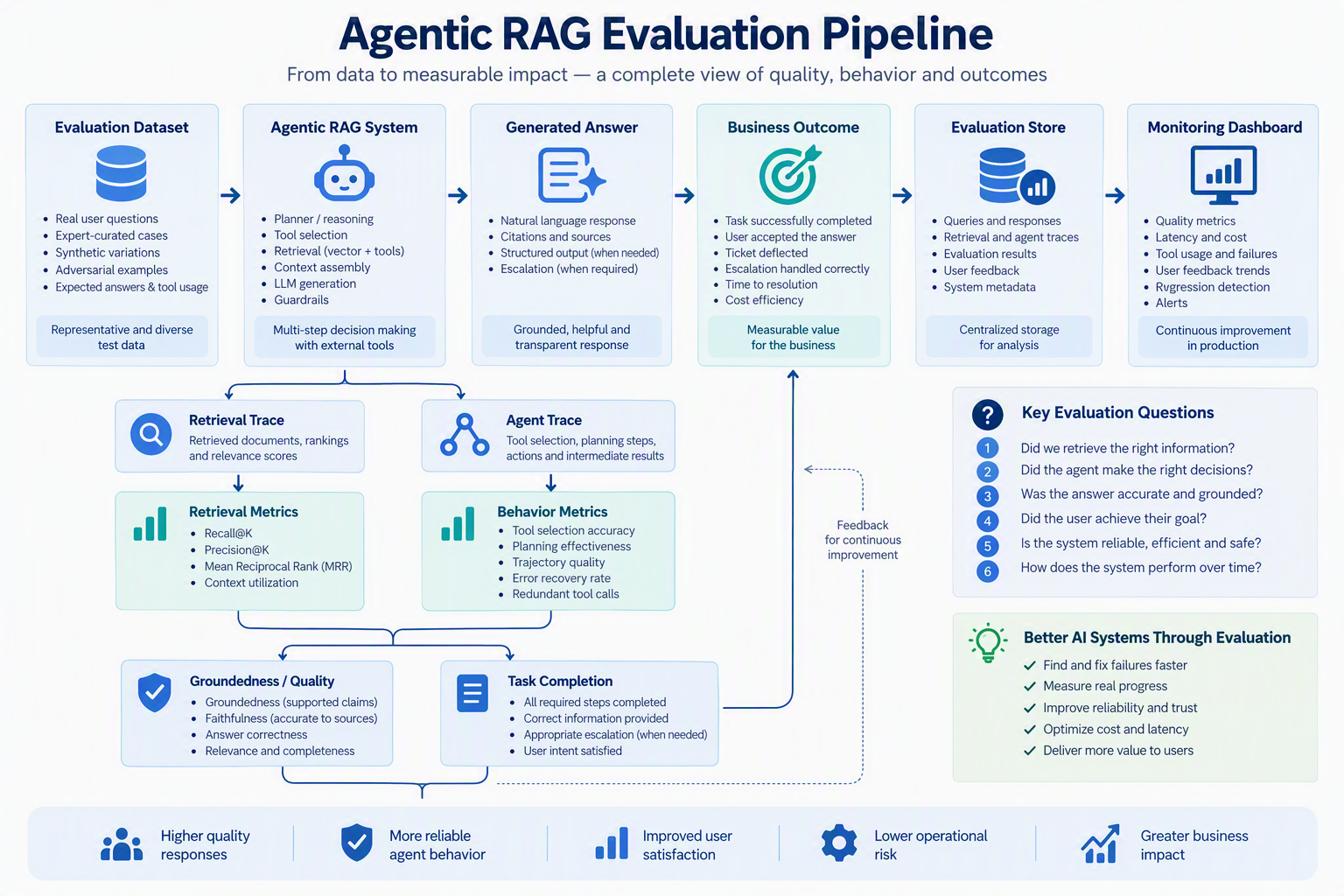
Agentic RAG evaluation should measure the complete system, from retrieval quality and agent decisions through generation quality and real-world business outcomes. A production evaluation strategy should examine four distinct layers.
| Layer | Core Question | | --- | --- | | Retrieval | Did the system retrieve the right information? | | Agent Behavior | Did the agent make the right decisions? | | Generation | Was the answer accurate and grounded? | | Business Outcome | Did the task actually succeed? |
Each layer tells us something different.
Evaluating only one creates blind spots.
Layer 1: Retrieval Evaluation
Retrieval remains the foundation of a RAG system.
If relevant information never reaches the model context, reliable answer generation becomes much more difficult.
Several metrics are particularly useful.
Recall@K
Recall@K measures how many relevant documents appear within the top K retrieved results.
Recall@K =
Relevant Documents Retrieved
----------------------------
Total Relevant Documents
Imagine that five documents are considered relevant to a query.
The retriever successfully returns four of them within the top ten results.
Relevant documents = 5
Relevant documents retrieved = 4

Recall@10 = 4 / 5 = 0.80
In many RAG scenarios, improving recall increases the probability that the model receives the evidence required to answer correctly.
However, recall alone is not enough.
Retrieving everything may improve recall while flooding the model with irrelevant context.
Precision@K
Precision@K measures how much of the retrieved information is actually relevant.
Precision@K =
Relevant Documents Retrieved
----------------------------
Total Documents Retrieved
Low precision introduces unnecessary information into the context.
That can increase:
- Noise
- Context length
- Model latency
- Token consumption
- Cost
- The risk of focusing on irrelevant evidence
A strong retrieval system therefore needs to balance recall and precision, rather than optimizing either metric independently.
Mean Reciprocal Rank
Mean Reciprocal Rank evaluates how highly the first relevant result appears.
For a single query:
Reciprocal Rank = 1 / rank of first relevant result
For example:
| First Relevant Position | Reciprocal Rank | | --- | ---: | | 1 | 1.0 | | 2 | 0.5 | | 5 | 0.2 | | 10 | 0.1 |
This matters because downstream systems often rely disproportionately on highly ranked results.
A relevant document appearing at position one can therefore have more practical value than the same document appearing at position ten.
Context Utilization
Retrieving a document does not mean the model actually used it.
Context utilization asks:
- How much retrieved content influenced the answer?
- Which retrieved chunks were ignored?
- Which sources supported individual claims?
- Are we retrieving far more context than the model needs?
Low utilization can indicate:
- Poor ranking
- Excessive retrieval
- Weak chunking
- Duplicate documents
- Context-placement problems
For mature RAG systems, measuring the relationship between retrieved evidence and generated claims becomes increasingly important.
Layer 2: Agent Behavior Evaluation
This is where evaluation of agentic systems begins to differ substantially from traditional RAG.
The system is no longer responsible only for retrieving information.
The agent is also making decisions.
Those decisions need to be evaluated.
Tool Selection Accuracy
Imagine an agent has access to:
1. Vector Search
2. Ticket Search
3. CRM API
4. Incident API
5. Escalation API
Now consider the request:
Which customers are affected by outage INC-1023?
Answering this may require a particular combination of tools, such as:
Incident API
     +
CRM API
Evaluation should determine whether the agent:
- Selected the correct tools
- Avoided irrelevant tools
- Passed appropriate parameters
- Called tools in a sensible sequence
- Used the returned information correctly
A simple metric might be:
Tool Selection Accuracy =
Correct Tool Decisions
----------------------
Total Tool Decisions
This measurement becomes particularly important as the available toolset grows.
An agent with three tools may be easy to evaluate manually.
An agent with dozens of enterprise tools is much more difficult.
Planning Effectiveness
Many agents create or implicitly follow a plan before reaching an answer.
For example:
Step 1: Search product knowledge base
Step 2: Retrieve incident history
Step 3: Compare evidence
Step 4: Generate grounded response
Evaluation should ask:
- Were all necessary steps included?
- Were unnecessary steps avoided?
- Were dependencies executed in the correct order?
- Did the agent recover appropriately when a step failed?
- Did the agent repeatedly perform the same unnecessary action?
Useful planning metrics can include:
| Metric | Purpose | | --- | --- | | Steps Executed | Efficiency | | Plan Success Rate | Correctness | | Average Replans | Stability | | Tool Failure Recovery | Resilience | | Redundant Tool Calls | Efficiency |
A correct answer generated through twelve unnecessary tool calls may technically succeed while still representing poor agent behavior.
Agent Trajectory Evaluation
One of the most valuable artifacts in an agentic system is the execution trajectory.
For example:
{
  "query": "How do I resolve authentication failure?",
  "steps": [
    "search_kb",
    "retrieve_policy",
    "generate_answer"
  ]
}
The trajectory exposes how the agent reached the final output.
Expert reviewers or automated evaluators can compare expected and observed trajectories.
Useful questions include:
- Did the agent search before answering?
- Did it select the appropriate source?
- Did it validate retrieved information?
- Did it call unnecessary tools?
- Did it prematurely stop?
- Did it recover from failed operations?
- Did it escalate when escalation was required?
Trajectory quality can reveal problems that final-answer evaluation completely misses.
A system that consistently follows strong trajectories is generally easier to debug and improve than one whose behavior varies unpredictably between executions.
Layer 3: Generation Evaluation
Even when retrieval and agent decisions are correct, the generated answer can still fail.
The generation layer therefore needs its own evaluation.
Groundedness
Groundedness measures whether statements in the generated response are supported by the supplied evidence.
Suppose the retrieved document says:
Password reset requires manager approval.
But the generated answer says:
Password reset requires manager approval
and MFA verification.
The MFA requirement was not present in the evidence.
That is a grounding failure.
A conceptual groundedness metric is:
Groundedness =
Supported Claims
----------------
Total Claims
A strong grounded answer should distinguish between information supported by retrieved context and information the model merely finds plausible.
Faithfulness
Groundedness and faithfulness are closely related but not identical.
Faithfulness asks whether the generated response accurately represents the source material.
Suppose the source states:
Premium support response time is 4 hours.
But the generated answer says:
Premium support guarantees issue resolution within 4 hours.
The generated sentence sounds plausible, but it changed response time into resolution time.
That difference may be operationally significant.
Faithfulness evaluation is often performed through a combination of:
- Deterministic checks
- LLM-based judges
- Domain-expert review
High-impact workflows should not depend exclusively on automated judgment.
Task Completion
For many enterprise workflows, task completion matters more than wording similarity.
Suppose a user asks:
How do I renew an expired API credential?
The useful evaluation question is:
Did the user receive all required steps
to successfully renew the credential?
not:
Did the response use the same wording
as the reference answer?
Task-completion evaluation is often much closer to the actual business objective than traditional language similarity metrics.
Layer 4: Business Outcome Evaluation
Eventually, stakeholders care about operational outcomes.
Technical quality is essential, but it is not the final objective.
Relevant metrics may include:
| Metric | Example Outcome | | --- | --- | | Resolution Rate | Support issue successfully solved | | Escalation Rate | Human involvement required | | User Acceptance | User accepted or positively rated the answer | | Deflection Rate | Support ticket avoided | | Time to Resolution | Task completed faster | | Revenue Impact | Improved sales-assistant performance |
The exact metrics depend on the application.
A customer-support agent, developer assistant and sales assistant should not necessarily be evaluated using the same business KPIs.
Most importantly:
A perfectly grounded AI system that does not help users complete their work is still an unsuccessful product.
Building an Evaluation Dataset
Evaluation quality depends heavily on evaluation data.
A common mistake is relying exclusively on synthetic test cases.
A strong production evaluation dataset typically combines three sources.
Historical User Data
Real production questions provide the most realistic representation of system usage.
Benefits include:
- Representative language
- Natural ambiguity
- Real edge cases
- Unexpected terminology
- Actual failure patterns
Historical data should of course be handled according to the organization's privacy, security and data-governance requirements.
Expert-Curated Benchmarks
Domain experts can create richer evaluation examples that describe not only the expected answer but also expected system behavior.
A benchmark record might conceptually contain:
question:
correct_tools:
relevant_documents:
expected_outcome:
Depending on the system, it could also include:
expected_escalation:
forbidden_actions:
expected_citations:
maximum_tool_calls:
This makes it possible to evaluate the agent, rather than only the generated prose.
Synthetic Expansion
Synthetic evaluation data can still be extremely useful.
Strong use cases include:
- Long-tail scenarios
- Rare incidents
- Stress testing
- Adversarial variations
- Query paraphrasing
- Boundary conditions
However:
Synthetic evaluation should complement real and expert-curated data, not replace it.
A benchmark composed entirely of model-generated questions may reproduce the assumptions of the same class of models being evaluated.
LLM-as-a-Judge in Agentic Systems
LLM-as-a-judge has become a practical technique for scaling qualitative evaluation.
A judge can evaluate criteria such as:
criteria:
  - correctness
  - groundedness
  - tool_use
  - completeness
  - policy_compliance
A simplified evaluation prompt might look like:
You are an expert evaluator.

Retrieved Context:
{context}

Agent Trace:
{trace}

Answer:
{answer}

Evaluate the response from 1 to 5.

Consider:
- correctness
- groundedness
- tool usage
- completeness
- policy compliance

Return the score and justify the evaluation.
LLM judges are useful because they can evaluate qualities that are difficult to represent with simple deterministic metrics.
However, they introduce their own limitations.
Judge models can exhibit:
- Bias
- Inconsistency
- Position effects
- Preference for certain writing styles
- Sensitivity to prompt wording
- Model-specific blind spots
A stronger evaluation strategy combines:
Objective metrics
        +
LLM-based evaluation
        +
Human expert review
No single judge should be treated as universally authoritative.
Production Monitoring After Deployment
Offline evaluation is necessary.
It is not sufficient.
Agent behavior changes over time because the surrounding system changes.
For example:
- Documents are updated
- Retrieval indexes change
- Prompt versions evolve
- Models are upgraded
- Tools change
- APIs change
- User behavior shifts
- New products or policies are introduced
Production telemetry should make individual agent executions observable.
A trace might capture:
request_id:
model:
prompt_version:
tool_calls:
retrieved_docs:
citations:
latency:
tokens:
cost:
user_feedback:
These signals make it possible to answer questions such as:
- Which prompt version caused the regression?
- Which retrieval query produced irrelevant evidence?
- Which tool is failing most frequently?
- Did latency increase after adding another agent step?
- Did groundedness decrease after a model upgrade?
- Which queries generate the highest cost?
Production Evaluation Dashboard
A practical dashboard may track:
| Metric | Desired Behavior | | --- | --- | | p95 Latency | Stable | | Retrieval Recall | High or improving | | Groundedness | High | | Cost per Request | Predictable | | Tool Failure Rate | Low | | Escalation Rate | Controlled | | Task Completion Rate | High | | User Feedback | Improving |
The objective is not necessarily to maximize every metric.
Trade-offs matter.
Improving answer quality by adding three retrieval passes and several tool calls may increase latency and cost significantly.
Evaluation should make those trade-offs visible.
Common Evaluation Anti-Patterns
Several evaluation mistakes appear repeatedly in production AI systems.
Measuring Only Answer Accuracy
A correct answer does not prove that the system behaved correctly.
The system may have:
- Retrieved irrelevant evidence
- Ignored evidence entirely
- Selected the wrong tool
- Hallucinated the right answer
- Taken an unnecessarily expensive path
Always evaluate the process as well as the output.
Ignoring Retrieval
Many apparent "LLM failures" are actually retrieval failures.
If the correct evidence never reaches the model, prompt engineering alone may not solve the problem.
Retrieval evaluation should therefore be treated as a first-class component of RAG evaluation.
Evaluating Components Only in Isolation
A retriever may perform well independently.
A model may perform well independently.
Tools may work correctly independently.
The complete system can still fail when these components interact.
Agentic systems require both:
Component evaluation
        +
End-to-end evaluation
Using Only Synthetic Benchmarks
Synthetic data is convenient and scalable.
But real production users introduce:
- Ambiguous requests
- Misspellings
- Domain terminology
- Missing context
- Conflicting goals
- Unexpected workflows
A synthetic-only benchmark rarely captures this complexity completely.
Skipping Human Review
Automated evaluation is essential at scale.
Human review remains valuable for:
- High-risk workflows
- New failure modes
- Evaluator calibration
- Domain-specific correctness
- Policy interpretation
- Ambiguous results
The goal is not to choose between automated and human evaluation.
The strongest evaluation systems use both.
Trade-Offs: Simple RAG vs Agentic RAG
Agentic RAG is not automatically better than traditional RAG.
The additional flexibility comes with additional operational complexity.
| Dimension | Simple RAG | Agentic RAG | | --- | --- | --- | | Quality potential | Moderate | Higher | | Cost | Lower | Higher | | Latency | Lower | Higher | | Explainability | Easier | More complex | | Evaluation effort | Lower | Much higher | | Operational risk | Lower | Higher |
Agentic RAG becomes particularly useful when workflows require:
- Multi-step reasoning
- Multiple data sources
- Tool invocation
- Workflow execution
- Decision making
- Recovery from intermediate failures
For straightforward knowledge search, traditional RAG may still be the better engineering choice.
The most sophisticated architecture is not automatically the most appropriate architecture.
A Practical Rollout Strategy
Agentic systems should not move directly from a notebook into unrestricted production use.
A staged rollout creates opportunities to identify failures safely.
Phase 1: Offline Benchmarks
Evaluate:
- Retrieval
- Tool selection
- Agent trajectories
- Groundedness
- Faithfulness
- Task completion
The objective is to establish a baseline before real users interact with the system.
Phase 2: Shadow Testing
Run the agent alongside existing workflows without allowing agent decisions to affect users or production processes.
Compare:
Existing System
       vs
Agent Decision
This can expose differences under realistic production traffic without immediately introducing operational risk.
Phase 3: Limited Release
Expose the system to a controlled subset of users or use cases.
Closely monitor:
- Failures
- Escalations
- User feedback
- Latency
- Cost
- Tool reliability
- Unexpected agent behavior
The purpose of this stage is learning, not simply proving that the system works.
Phase 4: Production Monitoring
Once broadly deployed, evaluation becomes continuous.
Monitor:
Retrieval
    +
Agent Behavior
    +
Generation
    +
Business Outcomes
A model deployment should never be considered permanently "evaluated."
The system and its environment continue to change.
Putting the Framework Together
A mature agentic RAG evaluation pipeline might therefore look like:
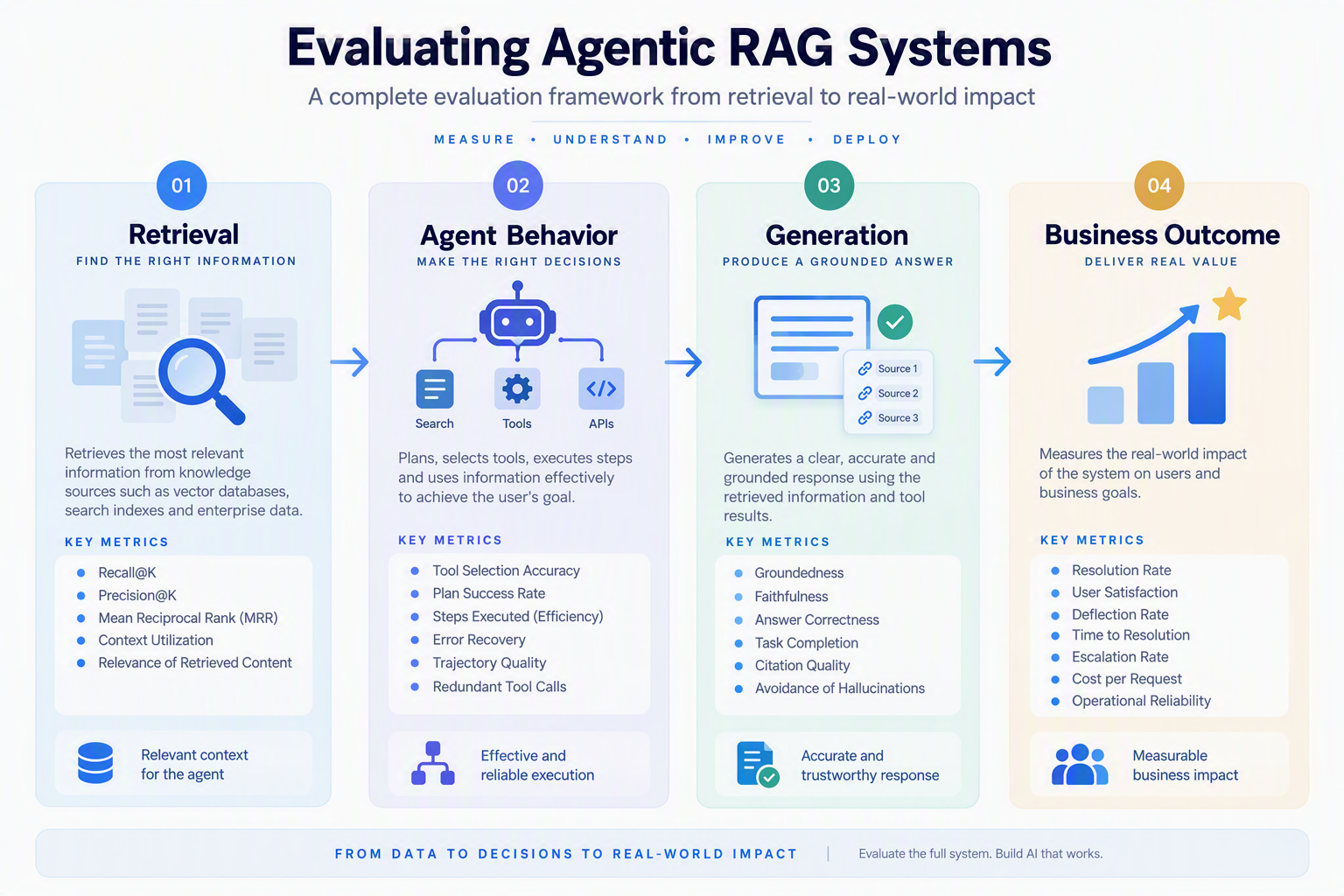
A mature evaluation pipeline connects offline test data, retrieval and agent traces, response-quality evaluation, task completion and production monitoring into a continuous improvement loop. The principle is simple:
Evaluate the system at the points where the system can fail.
For an agentic architecture, that means evaluating much more than the final text.
Final Thoughts
The biggest mistake teams make when evaluating agentic RAG systems is treating them like standalone language models.
An agentic application is a decision-making system composed of retrieval pipelines, models, tools, orchestration logic and external dependencies.
The final answer is only the visible output of a much larger execution graph.
A mature evaluation strategy therefore examines four layers:
Retrieval Quality
       +
Agent Behavior
       +
Generation Quality
       +
Business Outcomes
Teams that invest in all four dimensions gain something far more useful than a benchmark score.
They gain the ability to understand:
- Why the system succeeded
- Why the system failed
- Where quality is degrading
- Which component needs improvement
- Whether improvements actually benefit users
- Whether the system remains reliable as it evolves
The most reliable agentic RAG systems are not simply those with the highest answer accuracy on a benchmark.
They are systems whose behavior can be measured, explained, debugged and continuously improved.
Key Takeaways
- Evaluate retrieval, agent decisions, generation quality and business outcomes separately.
- Evaluate agent trajectories, not only final answers.
- Treat groundedness and faithfulness as first-class production metrics.
- Measure tool selection and planning quality in agentic workflows.
- Combine real production data, expert-curated benchmarks and synthetic test cases.
- Use objective metrics, LLM-as-a-judge and human review together.
- Track latency, cost and tool reliability alongside quality.
- Continue evaluation after deployment because models, data, prompts and users change.
- Use agentic RAG only when the added orchestration complexity provides meaningful value.
- Treat evaluation as a product capability, not a one-time testing activity.